 Women's Human Rights Institute of Korea (WHRIK)

 Submit an online counseling request regarding victimization.
What is Deletion Support?

What is deletion support?
If illegally filmed materials, image synthesis/editing materials, or non-consensually disseminated materials under Article 14 or 14-2 of the Act on Special Cases Concerning the Punishment of Sexual Crimes, or child or youth sexual exploitation materials under Article 2, Subparagraph 5 of the Act on the Protection of Children and Youth against Sex Offenses are disseminated online or suspected of being disseminated, it refers to the support measures taken to prevent the circulation of such materials.
are disseminated online or suspected of being disseminated, it refers to the support measures taken to prevent the circulation of such materials.
To minimize the spread of harm, we provide support including continuous monitoring, requesting deletion, and verifying completion.
I have videos or photos I want deleted. I wonder if these are eligible for deletion support.
- The victim-related images/videos eligible for deletion support by our Center refer to ‘sexual’ materials that were filmed, disseminated, synthesized, or edited ‘against the victim’s will.’
- Deletion support requests may be restricted for materials that were legally produced and distributed, or other materials without sexual exposure.
| Materials Eligible for Deletion Support | Examples |
|---|---|
|
① Child or Youth Sexual Exploitation Materials
|
Images/videos of body parts, such as genitals, demanded from a child or youth |
|
② Illegally Filmed Materials
|
Images/videos of secretly filmed sexual intercourse |
| Unauthorized recordings or captures of masturbation | |
|
③ Image Synthesis/Editing Materials
|
Images/videos in which a face is synthesized with pornographic material |
| A photo in which sexually insulting text is superimposed as subtitles over a facial photo | |
|
④ Non-Consensually Disseminated Materials
|
Images/videos of body parts (e.g., upskirt) filmed in a public place and disseminated |
| Images/videos of pseudo-sexual acts filmed with consent but disseminated without the victim's knowledge | |
| Self-filmed photos of genitals that were sent and subsequently disseminated | |
| Images/videos in which a stranger's exposed body is synthesized with the victim's face and disseminated |
① Child or Youth Sexual Exploitation Materials
- Depictions of children or youth, or of persons or representations that can be obviously perceived as children or youth, engaging in sexual intercourse, pseudo-sexual acts, acts involving contact with or exposure of all or part of the body, masturbation, or other sexual acts.
- * Can be categorized into illegally filmed materials, image synthesis/editing materials, and non-consensually disseminated materials depending on the production method.
- Images/videos of body parts, such as genitals, demanded from a child or youth
② Illegally Filmed Materials
- Cases where a person's body, which may cause sexual desire or shame, is photographed or filmed against the will of the person shot, by using a camera or other mechanism which has functions similar thereto.
- Images/videos of secretly filmed sexual intercourse
- Unauthorized recordings or captures of masturbation
③ Image Synthesis/Editing Materials
- Cases where a photograph, video, or audio recording (hereinafter "images/videos, etc.") targeting a person's face, body, or voice is edited, synthesized, or processed against the will of the person concerned into a form that may cause sexual desire or shame.
- Images/videos in which a face is synthesized with pornographic material
- A photo in which sexually insulting text is superimposed as subtitles over a facial photo
④ Non-Consensually Disseminated Materials
- Cases where illegally filmed materials, image synthesis/editing materials, or their duplicates (including duplicates of duplicates) are distributed, sold, leased, provided, or openly exhibited or shown (hereinafter "distribution, etc.").
- Cases where, even though the filming, editing, synthesizing, or processing was not against the will of the person concerned at the time (including where a person filmed his or her own body), the resulting images/videos, synthesized or edited materials, or duplicates are subsequently subject to distribution, etc. against that person's will.
- Cases where illegally filmed materials, image synthesis/editing materials, or duplicates are subject to distribution, etc. through an information and communications network for profit against the will of the person concerned.
- Images/videos of body parts (e.g., upskirt) filmed in a public place and disseminated
- Images/videos of pseudo-sexual acts filmed with consent but disseminated without the victim's knowledge
- Self-filmed photos of genitals that were sent and subsequently disseminated
- Images/videos in which a stranger's exposed body is synthesized with the victim's face and disseminated
- Even if you are eligible for support, it may be discontinued if an illegal act related to the requested materials is confirmed, or if you continue to produce or distribute the related materials after applying for support.
- However, for minor victims, even if the above reasons for restriction or discontinuation exist, comprehensive support is provided taking the circumstances of the victimization into account. Further details can be provided through counseling.
What is the difference between deletion support and dissemination status monitoring?
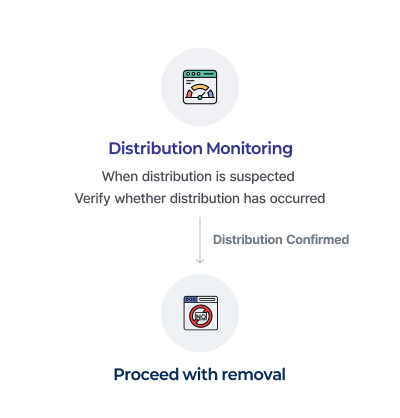
- Monitoring is support aimed at confirming whether dissemination has occurred; it is a fundamental step to locate URLs eligible for deletion support and is a form of deletion support.
- 'Dissemination status monitoring' refers to verifying whether the materials in question have been disseminated using keyword searches, internal center systems, etc., when no specific URLs have been found but dissemination is suspected.
- However, 'dissemination status monitoring' is only possible if the victim-related images/videos in video or photo format have been secured.
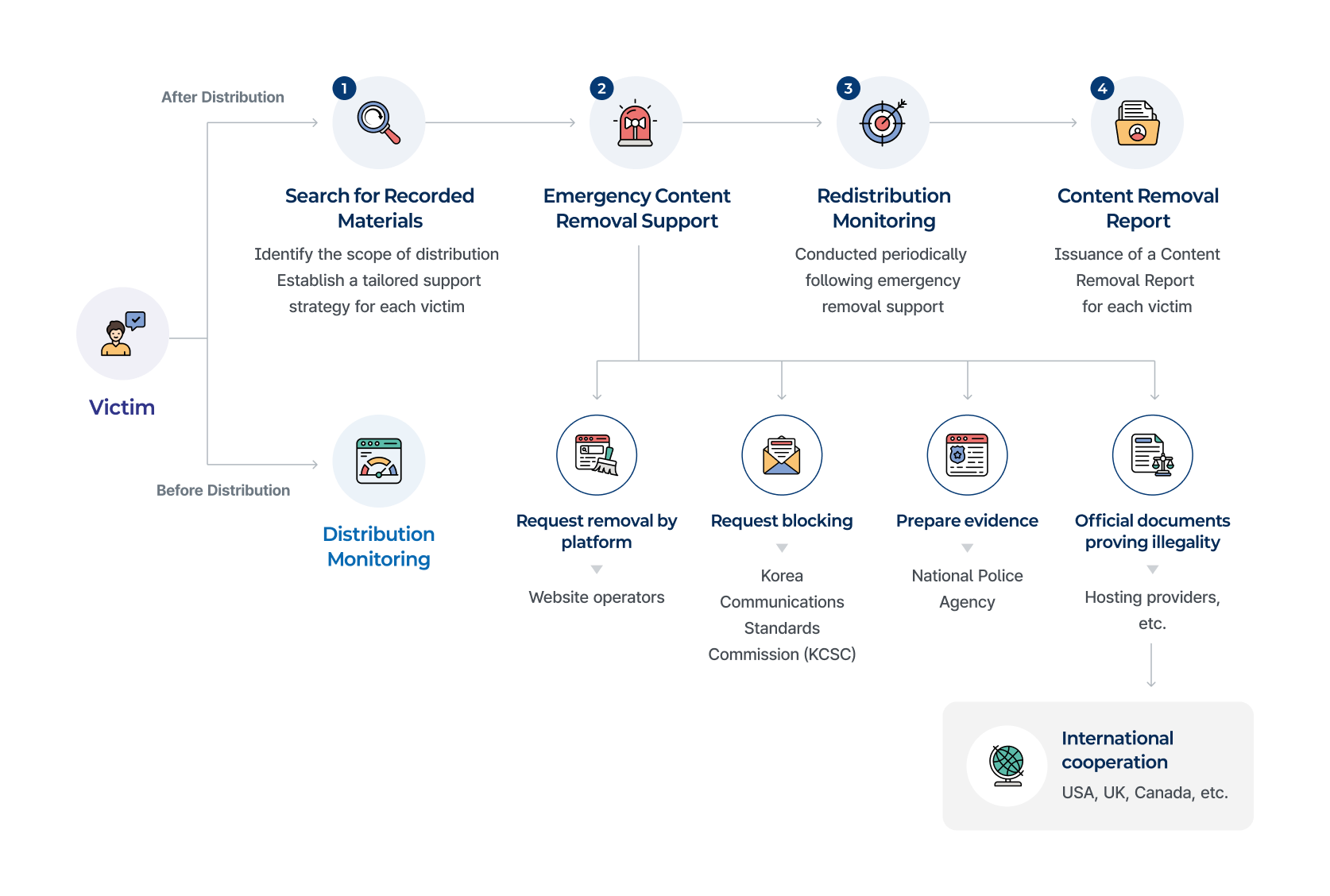
Deletion Support Flowchart
- If the disseminated materials are secured, deletion support begins.
- If no dissemination status is found, dissemination status monitoring is conducted; if URLs are discovered, deletion support begins.
- Deletion support targets all dissemination-related information, including the victim-related images/videos, thumbnails, and keywords.
- Deletion is requested by platform; if the request is not accepted, a blocking request is submitted to the Korea Communications Standards Commission (KCSC).