 Women's Human Rights Institute of Korea (WHRIK)

 Submit an online counseling request regarding victimization.
Fear of Distribution
Understanding Fear of Dissemination

Understanding Fear of Dissemination
-
1 When experiencing fear of dissemination due to the perpetrator's threats ① When experiencing fear of dissemination due to the perpetrator's threats
-
The perpetrator cunningly exploits the victim's anxiety to get what they want, such as sexual footage or money. Therefore, repeatedly reading or dwelling on threatening messages can amplify the fear that such an event will actually occur. If you receive threatening messages, it is crucial to quickly and firmly block the perpetrator and stop responding. You can minimize the harm by distancing yourself from the anxiety trigger (threatening messages) and responding with rational judgment rather than emotional reactions.
-
-
2 When experiencing fear of re-dissemination ② When experiencing fear of re-dissemination
-
Fear of re-dissemination is one of the most agonizing emotions experienced by victims of digital sexual crimes. It feels like living with a ticking time bomb; the fear of not knowing when or where one's private life might be exposed again fills every moment of daily life with anxiety. Feeling anxious after experiencing such harm is a completely normal reaction. However, if the anxiety persists and causes difficulties in maintaining daily life, efforts to reduce the intensity of the anxiety through appropriate coping strategies are necessary.
-

Understanding and accepting anxiety
Anxiety is a natural reaction, as sensing danger and being on guard is part of the protective instinct. When waves of anxiety hit you, tell yourself, “It is completely natural for me to be anxious right now. My body and mind are trying to protect me.” Acknowledging and accepting the emotion, rather than trying to suppress it, is the first step.
-

Reducing attempts to control uncertainty
After the harm occurs, you experience anxiety over a situation you cannot control, that is, uncertainty: ‘where, how, and how much your photos or videos have spread, and not knowing what will happen in the future.’ To control this uncertain situation, you might engage in behaviors like searching your name or keywords to find the disseminated material, or continuously checking if the video has been deleted after receiving deletion support.
However, you must refrain from these behaviors; finding disseminated materials causes re-traumatization, inflates the anxiety that ‘it must be out there somewhere,’ and can even cause the videos to rank higher on search portals. To restore a healthy sense of control, you need to shift your focus from ‘uncontrollable external factors (disseminated materials, the gaze of others)’ to ‘controllable internal factors (your own reactions, behaviors, and daily life).’ What are the ways to restore a healthy sense of control? -

Restoring a healthy sense of control
-
1. Creating your own ways to cope with anxiety
Fear of re-dissemination tends to worsen especially late at night or when you are alone. To prepare for this, it is good to set up a coping plan in advance. Make a list of activities you can do when anxiety arises. Find methods that work for you, such as listening to favorite music, drinking warm tea, calling a friend, doing light exercise, or writing in a diary. Putting these methods into practice and experiencing a positive sense of ‘self-efficacy’—knowing that you are coping with your anxiety yourself—is very helpful.
-
2. Caring for your body and mind and shifting your focus
Anxiety also affects the body. You may experience symptoms like chest tightness, insomnia, and loss of appetite. At times like this, you need to pay even more attention to basic self-care. Make sure to eat regular meals, get enough sleep, and move your body with light exercise or a walk.
-
3. Connecting with trusted people
Isolation fuels anxiety further. Maintain connections with trusted people among your family, friends, and colleagues. You don't need to explain the whole situation in detail, but simply letting them know in advance—"I'm going through a hard time lately, so I might reach out from time to time"—is helpful. Also, meeting regularly with a professional counselor or psychotherapist to sort out your emotions and develop coping strategies is extremely important.
-
-
-
3 When vague anxiety arises that harm (illegal filming and dissemination) might have occurred ③ When vague anxiety arises that harm (illegal filming and dissemination) might have occurred
-
There are cases where you are overwhelmed by a vague ‘what if’ anxiety even though actual harm has not been confirmed. ‘What if it gets disseminated?’ ‘What if someone I know sees it?’ Thoughts starting with ‘what if’ like this lead to endless chains of thought, making the mind even more anxious and eventually consuming our daily lives. The more we try to somehow solve problems that cannot be verified or solved immediately, the deeper we fall into a swamp of anxiety and confusion. The most effective way to break this cycle of anxiety is not to confront vague imaginations, but to focus on and respond to what you can do ‘right here, right now’. What you can do now is turn the anxious question, ‘What if ~ happens?’, into an empowering declaration, ‘If ~ happens, I will handle it like this!’ and fully familiarize yourself with coping strategies through counseling in case harm does occur.
-
How to Cope
How to Cope
-
1
How to cope when anxious and negative thoughts persist
① Coping with Negative ThoughtsIf you become absorbed in anxious and negative thoughts to an uncontrollable degree, it is necessary to learn methods to regulate them and cope appropriately.
-
1
Shouting ‘Stop’ or ‘Quit’ (Thought-stopping technique)
The thought-stopping technique involves stopping negative thoughts whenever they arise by shouting ‘Stop’ or ‘Quit’ out loud (or shouting it in your mind) to yourself, or by doing an action like clapping your hands. After stopping the thought, you shift your attention to another thought or activity (drinking water, counting numbers, looking at photos of a pet dog, etc.).
-
2
Changing emotional reactions into realistic thoughts
When a negative thought arises, it is necessary to reframe it with a realistic thought rather than an emotional reaction.
Ex) Try refuting negative thoughts
-
Everyone will recognize me!

Not everyone watches videos on illegal sites, and the number of video clicks might be an inflated number rather than the actual number of viewers. For example, suppose you run into a celebrity on the street. Just as it is not easy to recognize their everyday appearance, your appearance in a video is very different from reality, making it highly unlikely for others to recognize you.
-
I can't solve this problem!
Counseling with a victim support organization and asking for help is also part of the process of solving the problem. I have the power and the right to solve this problem.
-
My video will never be deleted!
Deletion technology is advancing every year, and even if just one piece of footage is deleted, it is far better than doing nothing.
-
No one understands me, I am alone!
There may be situations where you cannot tell your parents, siblings, or friends, or ask for help. However, there are many organizations that support and stand with victims. You are not alone.
-
My life is over!
This incident is not the end of your life. Many victims have overcome difficult times and restored ordinary daily lives, such as getting married, having children, and getting a job. We are currently in the midst of that process, and we are navigating it successfully.
-
-
3
Not blaming yourself and reassuring yourself
This incident is ‘not my fault’. The shame and guilt about the incident belong entirely to the perpetrator. You are bravely facing this situation right now, and you are stronger than ever. Give yourself a warm hug and say to yourself:
-
-

“I am safe now.”
-
“It's okay, I am coping well right now.”
-
“It is natural for me to be anxious right now. But this emotion will pass.”
-
-
-
2
How to cope when overwhelmed by anxious emotions
② Coping with anxious feelingsWhen anxious emotions rush in all at once, you may experience being overwhelmed by emotions, such as your body freezing up, your heart rate increasing, and breaking out in a cold sweat. When overwhelmed by emotions, it is good to cope appropriately utilizing relaxation techniques. Relaxation techniques are highly effective in alleviating states of stress, anxiety, and tension.
Easy-to-use relaxation techniques
Source: National Center for Mental Health, National Center for Disaster and Trauma ‘Stabilization Techniques’-
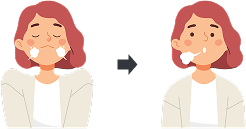
Deep breathing method
-
1
Inhale through your nose.
-
2
Exhale slowly through your mouth with a ‘whoosh’.
-
3
Exhale slowly while focusing on the feeling of the breath leaving your chest.
-
4
Repeat the above sequence 3 times as 1 set, for 3 sets.
-
1
-

Butterfly hug method
-
1
With your arms crossed over your chest, place both hands on your opposite upper arms.
-
2
Tap lightly and alternately side to side about 10–15 times, like a butterfly fluttering its wings.
-
3
Give yourself a ‘self-pat’ by tapping your body side to side.
-
1
-
-
3
How to cope when you can't easily fall asleep due to anxiety
③ Coping with Persistent AnxietyExcessive stress, anxiety, and negative thoughts can lead to physical reactions and cause insomnia. When it is difficult to fall asleep, it is important to relieve tension with a warm shower and create an environment where your body and mind can relax, rather than forcing yourself to sleep. Please refer to the methods that help with sleep below.
-
Sites helpful for insomnia:
-
National Center for Mental Health, National Center for Disaster and Trauma ‘Sleep Hygiene: Guidelines for Healthy Sleep’
-
Sleep Hygiene: https://www.nct.go.kr/distMental/rating/rating01_5_4.do
-
Moving toward recovery
Our goal is not to eliminate anxiety completely, but to live with this anxiety while lowering its intensity to maintain daily life. Through the stories of victims living their lives after experiencing harm, we hope you take a courageous step toward recovery today.
-
1 Step one for recovery: Experiencing warm emotions ① Experiencing Warm Emotions
“During counseling, I didn't even realize my anxiety levels were so high. Being able to objectively feel, 'Oh, my anxiety is high; this is the state I am in,' and just being able to talk about it helped me a lot.”
Source: Women's Human Rights Institute of Korea (WHRIK), A Study on the Experience of Harm from Dissemination and Fear of Dissemination in Digital Sexual Crimes
-
Talking with someone you trust and receiving emotional support also aids in recovery. A trusted person is ideally a safe figure (parent, sibling, senior, friend, counselor, etc.) who empathetically understands your situation and respects your story with unconditional positive regard.
-
Victims report that seeing their support figures treat them as their normal selves, unaffected by the incident, was an immense help in recovering and returning to daily life.
-
-
2 Step two for recovery: Creating a daily routine ② Creating a daily routine
“Diligently doing the things I have to do every day... I also really like cooking, and as I focus on it, I forget about the anxiety in that moment.” “I am the type to exercise almost every day, to the point where I'd say I exercised to survive, and it really helps. Exercising every day, doing the things you just have to do daily (those things helped).”
Source: Women's Human Rights Institute of Korea (WHRIK), A Study on the Experience of Digital Sexual Crime Dissemination and Fear of Dissemination Damage
-
Psychological trauma disrupts daily routines such as meals, sleep, and interpersonal relationships. To recover, it is necessary to rebuild your daily routines. If you cannot stick to everything perfectly, deciding on and practicing just one personalized recovery routine per day is also helpful.
-
-
3 Step three for recovery: Fostering hope for the future ③ Fostering hope for the future
“I thought, 'I'm going to live an abnormal life from now on. I'm just going to live alone, stay alone in the corner of my room, and die.' But now, I think I'm living a somewhat normal life that fits the standard of being normal. (I got married and had a baby too) So I think I am quite satisfied right now.”
Source: Women's Human Rights Institute of Korea (WHRIK), A Study on the Experience of Digital Sexual Crime Dissemination and Fear of Dissemination Damage
-
It may feel like the current pain will last forever, but time has a powerful healing force. As time passes, many victims gradually regain their daily lives, form new relationships, and engage in meaningful activities. Even if it is hard right now, try setting small goals first. Think about what you want to do next week, who you want to meet next month, and what you want to learn this year, and gradually grow your expectations for the future.
-
Above all, please remember. The difficulties you are experiencing right now are not your fault, and they are not a burden you have to endure alone. Asking for help is a brave act and a powerful step toward recovery. Whenever you are struggling, please seek help from professional organizations and walk the path of healing slowly at your own pace.
-
Organizations where you can get help
Organizations where you can get help
-
1 Regional Digital Sexual Crime Victim Support Center ① Regional Digital Sexual Crime Victim Support Center
-
Counseling support, investigative support, legal support, medical/recovery support, financial support (treatment costs, emergency living expenses, etc.)
-
-
2 Women's Emergency Hotline 1366 ② Women's Emergency Hotline 1366
-
Call 1366 without an area code or search for ‘Cyber Counseling for Violence Against Women’ on KakaoTalk
-
Counseling available 24/7, 365 days a year, can be linked to Digital Sexual Crime Victim Support Centers nationwide
-
-
3 Local Sexual Violence Counseling Center ③ Local Sexual Violence Counseling Center
 Find Ministry of Gender Equality and Family (MOGEF) facilities:
https://www.mogef.go.kr/inc/fs_fsc_s003.do
-
Free investigative support, legal support, psychological support, medical expense support, etc.
-
-
4 Mental Health Crisis Counseling 1577-0199 ④ Mental Health Crisis Counseling 1577-0199
-
Call 1577-0199 or access online counseling through the website of each regional Mental Health Welfare Center
-
Counseling available 24/7, 365 days a year; provides mental health counseling and information
-
-
5 National Center for Disaster and Trauma ⑤ National Center for Disaster and Trauma
-
Psychological reaction self-assessment:
https://www.nct.go.kr/distMental/rating/rating02_1.do -
Stabilization technique videos:
https://www.nct.go.kr/distMental/crisis/crisis01_4_6.do
-